
The Academic Programs to serve Hawaiʻi's Diverse Peoples
This exhibit features a history of
- The Pre-Admissions to the Ulu Lehua Scholars Program. This program was an attempt to implement civil rights & diversity initiatives at the William S. Richardson School of Law at its founding. The vision was that the curriculum could empower the people of Hawaiʻi, particularly those who could not afford to attend law school in the continental U.S., to have access to rigorous and relevant legal training in the islands, and to diversify the Hawaiʻi Bar.
- Other academic programs were designed to meet the vision to serve the legal needs of diverse, vulnerable groups in Hawaiʻi society, as well as to advance legal knowledge necessary for the governance of Hawaiʻi's complex, globalized island society.
Sources:
Laurie Arial Tochiki. The Ulu Lehua Program at the William S. Richardson School of Law. Policy Context and Lived Experience, A Phenomenological Case Study. Dissertation for Doctor of Philosophy, University of Hawai'i at Mānoa, 2015.
"Academics." William S. Richardson School of Law, Honolulu, 2023. https://law.hawaii.edu/


1973
The demographics of the entering class Statistics according to
- Age, Gender, and Place of Birth
- Total Applications Accepted by Gender and by Ethnic Profile
- LSAT Averages and Registered Students by Gender and Ethnic Profile
reveal who was represented and underrepresented in the early years of the law school. Since the law school's vision was to diversify the Hawaiʻi Bar, it was important to recruit students from ethnic populations that were not highly represented in the bar. Local and regional histories of colonialism, war, displacement, and racialized labor generated societal inequalities according to race, ethnicity, class, gender, and immigration status, which affected diverse students' previous educational training and skill sets. Therefore the law school's curriculum had to be designed to support the needs of students from underrepresented backgrounds so that they may be given an opportunity to succeed in their legal training.
Sources:
Law School History Collection, Series 10: General Box 1, Folder 24
Law School History Collection, Series 10: General Box 1, Folder 25
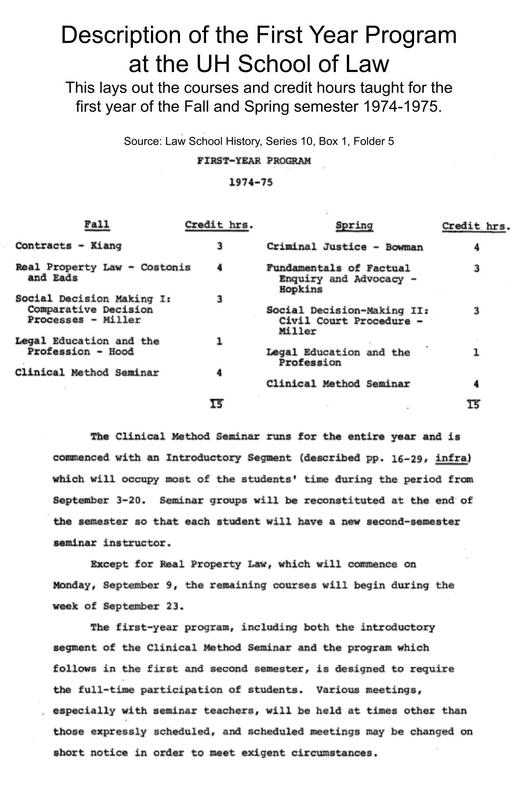

1974
First Year Program
The Description of the First Year Program at the UH School of Law lays out the courses and credit hours taught for the first Fall and Spring semesters in 1974-1975. In the Fall, courses on contracts, real property law, social decision-making, legal education & the profession, and clinical methods were taught. In the Spring, criminal justice, fundamentals of factual inquiry and advocacy, social decision-making, and legal education and the profession, and clinical method seminar were taught.
Pre-Admissions Program
George Marion Johnson (1900-1987) was recruited by Chief Justice Richardson to design the Pre-Admission Program. Johnson was a civil rights attorney and Dean of Howard University Law School who advocated to increase Black lawyers in the profession. Johnson directed the University of Hawai’i School of Law Pre-Admission Program for 1 year before he retired. His program focused on the teaching of legal writing; advocacy; law for remedy, dispute, and social justice; student support, and introduction into the the legal realm.
Source: Law School History Collection, Series 11: Law School Publications, Box 2, LSHDA 1:71

1976
Cory Park served as Director of the Pre-Admissions Program as part of his faculty duties in 1976. This "Except from Prof. Cory Park's syllabus on "Poverty Law Fall, 1975” covered eligibility conditions, equal protection, determination of the benefit level, employment discrimination, and a syllabus for a course on contracts.
Carol Mon Lee served as Director of the Pre-Admissions Program in 1976-1977.
1977
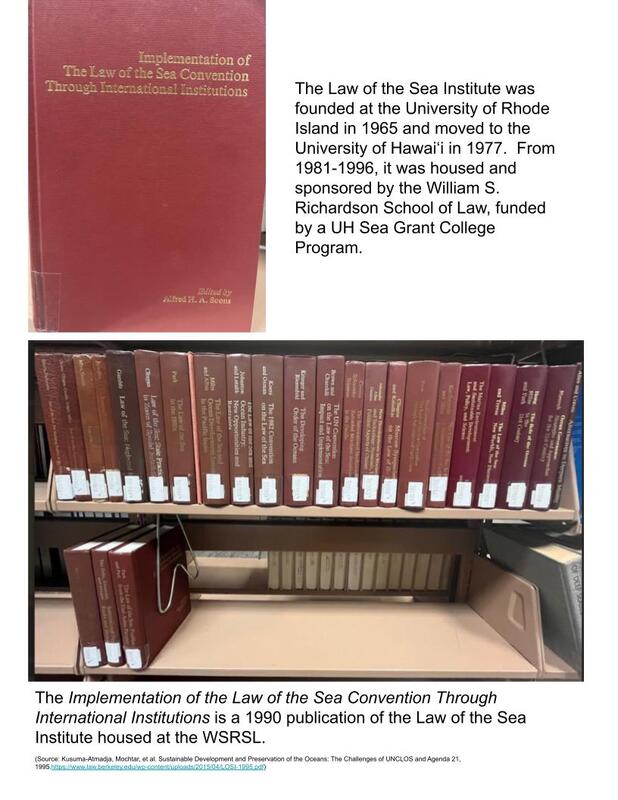
The Law of the Sea Institute was founded at the University of Rhode Island in 1965 and moved to the University of Hawaiʻi in 1977. From 1981-1996, it was housed and sponsored by the William S. Richardson School of Law, funded by a UH Sea Grant College Program.
The Implementation of the Law of the Sea Convention Through International Institutions is a 1990 publication of the Law of the Sea Institute housed at the WSRSL.
WSRSL Professor Jon Van Dyke was a researcher on the Law of the Sea. In this snapshot of PowerPoint slides, he covers how high-seas fisheries are impacted by climate change. But also, how laws of the seas--the 1982 Law of the Sea Convention, 1995 Straddling and Migratory Fish Stocks Agreement, and 2000 Honolulu Convention on Western and Central Pacific Highly Migratory Fish Stock--govern high seas fisheries.
Sources:
Kusuma-Atmadja, Mochtar, et al. Sustainable Development and Preservation of the Oceans: The Challenges of UNCLOS and Agenda 21, 1995.https://www.law.berkeley.edu/wp-content/uploads/2015/04/LOSI-1995.pdf)
“Allocation of High Seas Fisheries,”Jon Van Dyke Archives, Series 4: Ocean Law, 5C2: 160
1978
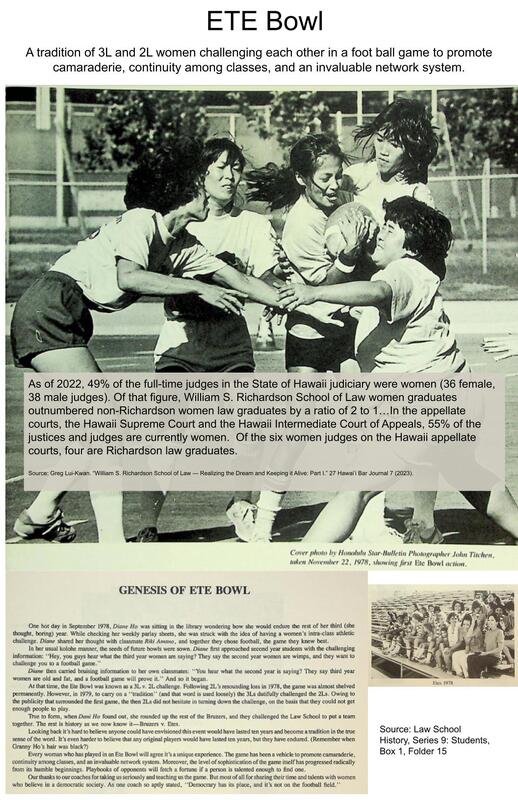
The ETE Bowl started in 1978 as a tradition of 3L and 2L women challenging each other in a football game to promote camaraderie, continuity among classes, and an invaluable network system. As a result of this extracurricular activity among students, it built relationships and connections among female students that would help them throughout their careers.
According to alumnus Greg Lui-Kwan, "as of 2022, 49% of the full-time judges in the State of Hawaii judiciary were women (36 female, 38 male judges). Of that figure, William S. Richardson School of Law women graduates outnumbered non-Richardson women law graduates by a ratio of 2 to 1…In the appellate courts, the Hawaii Supreme Court, and the Hawaii Intermediate Court of Appeals, 55% of the justices and judges are currently women. Of the six women judges on the Hawaii appellate courts, and four are Richardson law graduates."
Sources:
Greg Lui-Kwan. “William S. Richardson School of Law — Realizing the Dream and Keeping it Alive: Part I.” 27 Hawai’i Bar Journal 7 (2023).
Law School History, Series 9: Students, Box 1, Folder 15
1979
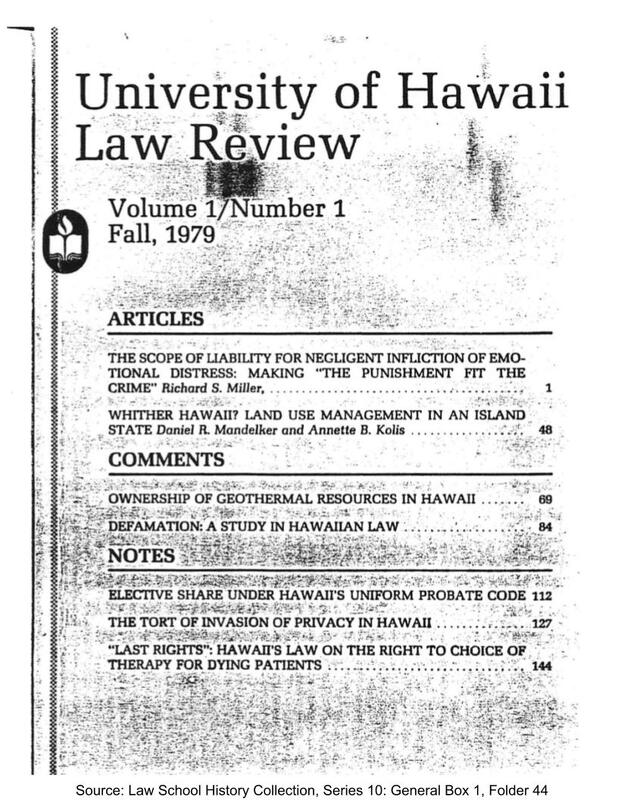
The UH Law Review was established in the Fall of 1979 with the first articles entitled "The Scope of Liability for Negligent Infliction of Emotional Distress: Making 'The Punishment Fit the Crime'" by Richard S. Miller, and "Wither Hawaii? Land Use Management in an Island State" by Daniel R. Mandelker and Annette B. Kolis.
There were comments entitled "Ownership of Geothermal Resources in Hawaii" and "Defamation: A Study in Hawaiian Law."
There were also notes entitled "Elective Share Under Hawaiiʻs Uniform Probate Code," "The Tort of Invasion of Privacy in Hawaii", and "ʻLast Rights': Hawaii's Law on the Right to Choice of Therapy for Dying Patients."
In a letter of correspondence between William S. Richardson and John Spade about the Law Review, Richardson included a blessing for this first UH Law Review edition. He wrote:
Hō mai ka ʻike nui, ka ʻike iki.
Grant knowledge of the great things, and of the little things.
Richardson also wrote,
"The tenor and nature of the law in Hawaiʻi have changed since statehood with the recognition that Hawaiʻi's people can create, administer, and interpret their own laws and thereby guide and direct their own future. The University of Hawai'i School of Law is an integral part of that change and was founded with the hope that the law school community, its students, its faculty, and especially its graduates, would help give form and substance to the people's combined vision of Hawaiʻi's future. The law review, like the law school itself, must play a major role in helping us to understand our laws and their effect upon that vision."


1982
Accreditation of the Law School
The American Bar Association approved the accreditation of the University of Hawai’i School of Law in 1982.
Pacific Islands Judicial Education
Since 1982, American law professors in Micronesia, the Supreme Court of the Federated States of Micronesia, the Supreme Court of the Republic of Palau, and the William S. Richardson School of Law at the University of Hawaiʻi, worked together to establish a unique program of judicial education and training. New constitutions, governments, and political leadership emerged in the Federated States of Micronesia and the Republic of Palau, resembling American counterparts. The judicial education program aimed to generate proficiency in common law analysis and decision-making among Micronesian Judges, as well as establish a common law that embodies the traditions and aspirations of their Micronesian peoples.
Chief Justice Edward C. King, author of “Judicial Institute of the Pacific: A Concept Paper,” wrote:
"Many Pacific Island nation's laws have been adopted from ʻmetropoles,ʻ but Pacific Island citizens are non-citizens to those nations that would provide them legal training. As such citizen attorneys have emerged in Pacific nations to deal with challenges of conflict and changes affecting their islands. The Judicial Institute of the Pacific was envisioned to
- Support for Judicial Administration
- Judicial Education
- Staff Training
- Translation
- Experimentation and Adaptation
- Publication of the Pacific Islands Reporter
- Establishing the Pacific Islands Research System
- Setting up Appellate Panels
- Creating Opportunities for Legal Education
- Establishing of Standards
- Developing Pacific Island Attorneys
- Rules for Judicial Discipline
- Codification"
The Judicial Institute of the Pacific provides the context for the establishment of the Pacific Island Legal Institute at the William S. Richardson School of Law, which welcomes Judges from throughout the Pacific to engage in continuing education.
Ka Huli Ao Center for Excellence in Native Hawaiian Law co-hosted the Customary and Traditional Law Conference with the Pacific Judicial Council on-site at the William S. Richardson School of Law from June 20-22, 2023. The Conference included judges, attorneys, and staff from across the Pacific region with a total of seven jurisdictions represented. The Pacific Judicial Council assists in the development and delivery of continuing judicial education and court professional training, and overall improvement of the administration of justice in the member courts.
Sources:
Addison Bowman. “Judicial Seminars in Micronesia.” 9 University of Hawaiʻi L. Rev (1987)
Chief Justice Edward C. King, author of “Judicial Institute of the Pacific: A Concept Paper.” University of Hawaiʻi School of Law Library Archives, Pacific Island Committee
Ka Huli Ao Center for Excellence in Native Hawaiian Law, 2023. https://www.facebook.com/kahuliao

1985
Native Hawaiian Rights
Early Native Hawaiian Rights syllabus by Wanda Chong and William Tam. It covers ancient land system, private property, public land laws, Ceded Lands Trust, OHA, Hawaiian Homes Commission, fishing and ocean Rights, public access rights, religion, water rights, public trust doctrine, quiet title, land reform and homesteading.
Business Law
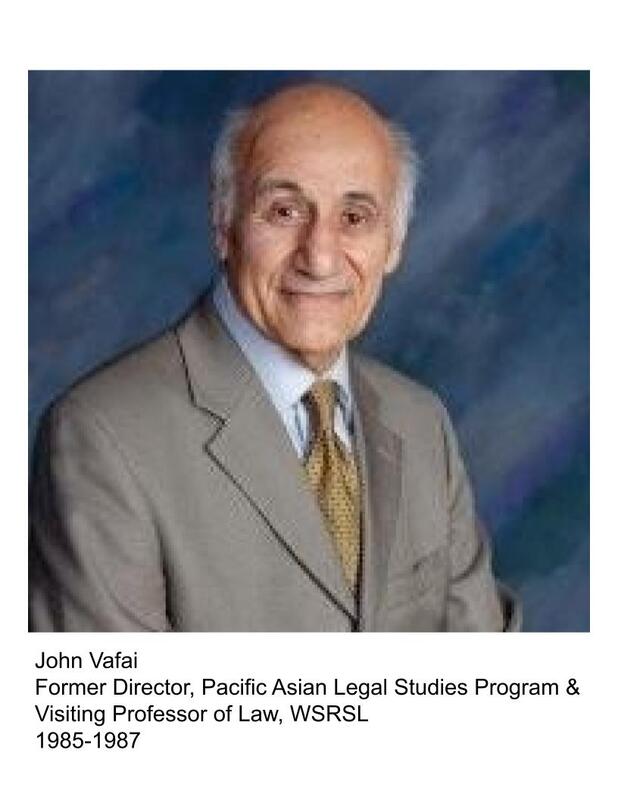
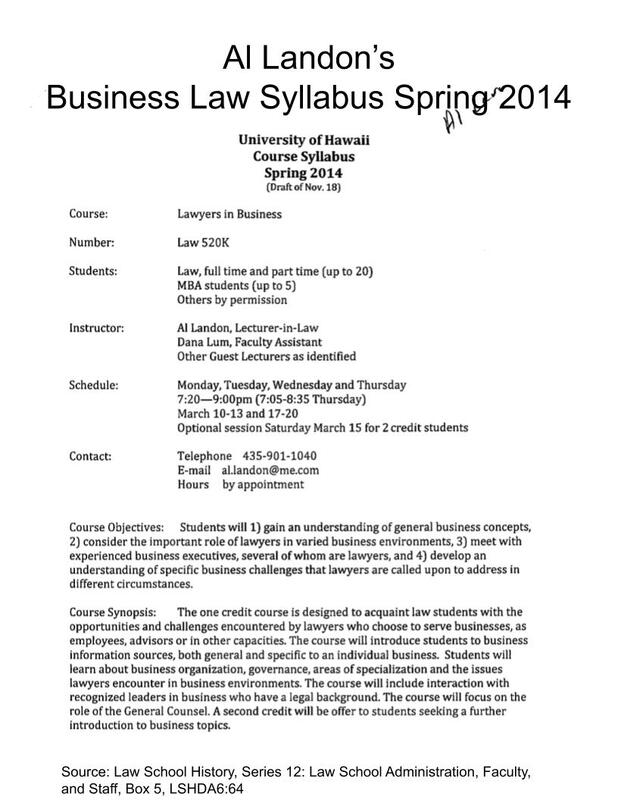
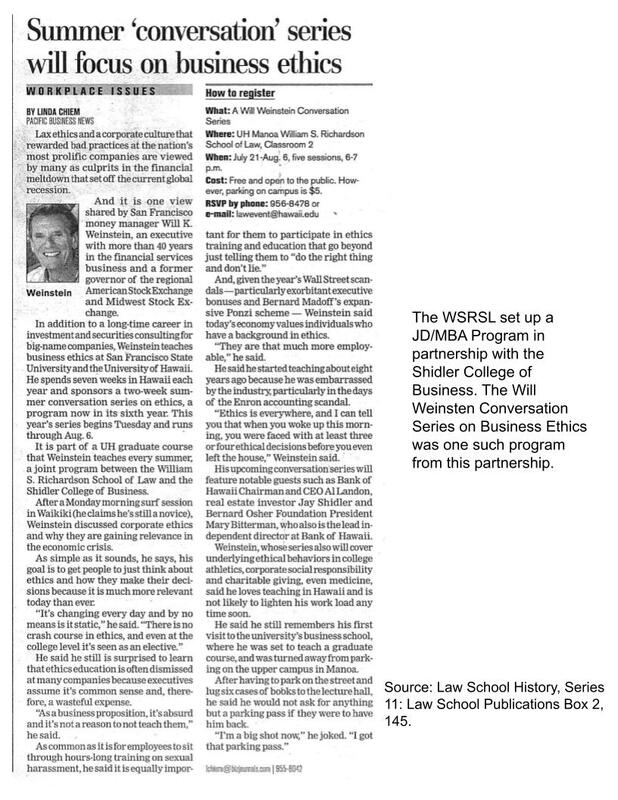
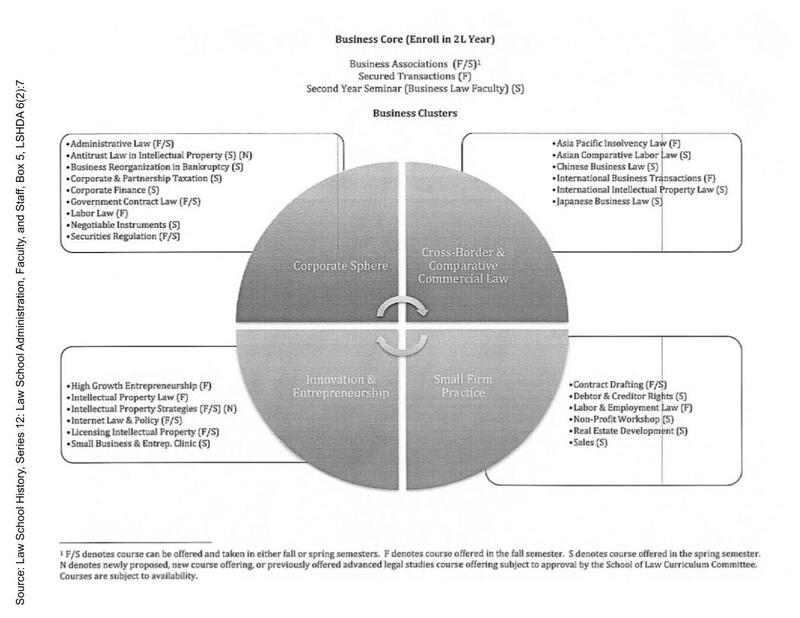
Business studies at the WSRSL began in 1985 through the Pacific Asian Legal Studies International Business Transactions course taught by John Vafai. Over the years, different law faculty would evolve the program, bringing in new ideas to teach the Business Law curriculum.
Source: Law School History, Series 12: Law School Administration, Faculty, and Staff, Box 5, Folder 41.

1987
Judy Weightman (1941-1998) was director of the Pre-Admissions Program 1987-1998. She was known as a civil rights activist, educator, historian, and film producer…a woman of uncommon valor.
Source: Law School History, Series 12: Chris Iijima & Judy M. Weightman Memorabilia Box 2, Item 5
1991
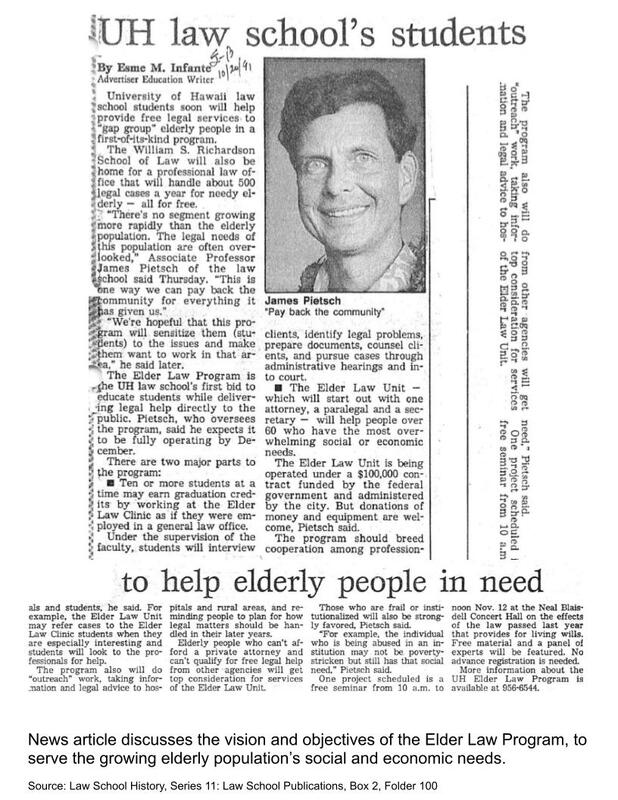
A news article discusses the vision and objectives of the Elder Law Program, to serve the growing elderly population’s social and economic needs. Pictures feature Professors Jim Pietsch and Calvin Pang leading elder law workshops.
Source: Law School History, Series 11: Law School Publications, Box 2, Folder 100

1996
A proposal advocates for the Certificate Program in Environmental Law by describing the need for environmental law training for local firms and agencies in Hawaiʻi. Pictures of an Environmental Law program event at the WSRSL feature Dean Foster, Denise Antolini, and Casey Jarman.

1998
Pre-Admission Program
Michael Tanigawa was hired as interim director of the Pre-Admission Program in 1998.
Professor Eric K. Yamamoto, committee chair, submits the report of the Pre-Admissions Program Review Committee University of Hawaiʻi Law School to Dean Lawrence Foster.
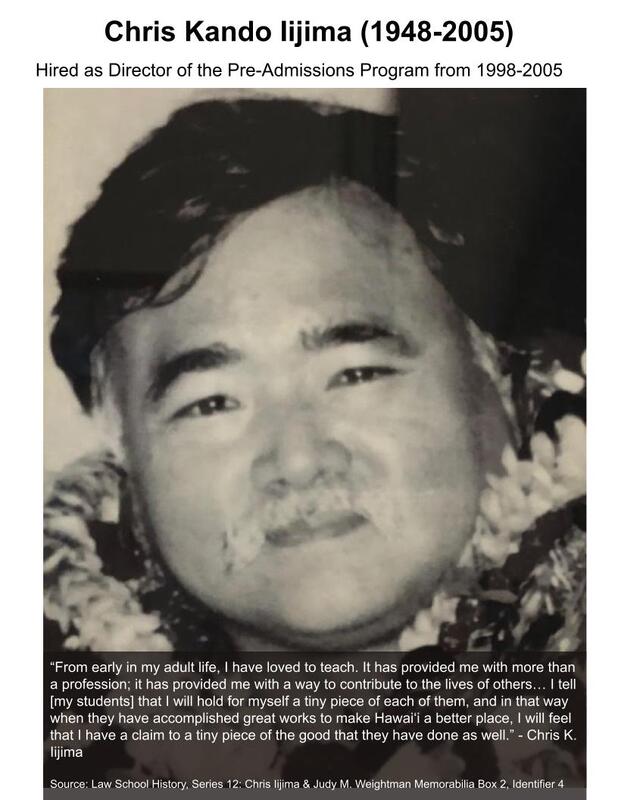
Chris Kando Iijima (1948-2005) was hired as Director of the Pre-Admissions Program from 1998-2005. He wrote,
“From early in my adult life, I have loved to teach. It has provided me with more than a profession; it has provided me with a way to contribute to the lives of others… I tell [my students] that I will hold for myself a tiny piece of each of them, and in that way when they have accomplished great works to make Hawaiʻi a better place, I will feel that I have a claim to a tiny piece of the good that they have done as well.”
Pacific-Asian Legal Studies
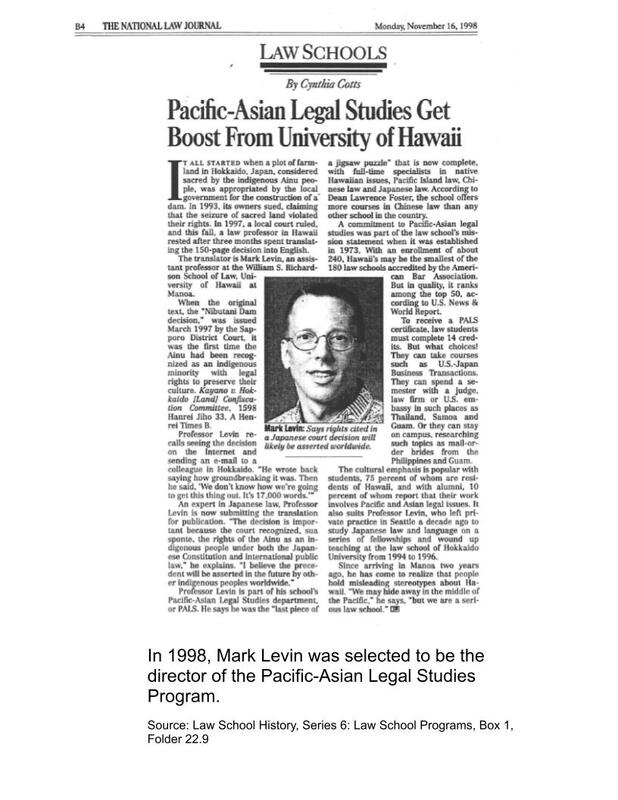
In 1998, Mark Levin was selected to be the director of the Pacific-Asian Legal Studies Program.
Sources:
Law School History, Series 12: Chris Iijima & Judy M. Weightman Memorabilia Box 2, Identifier 4
Law School History, Series 6: Law School Programs, Box 1, Folder 22.9
1999
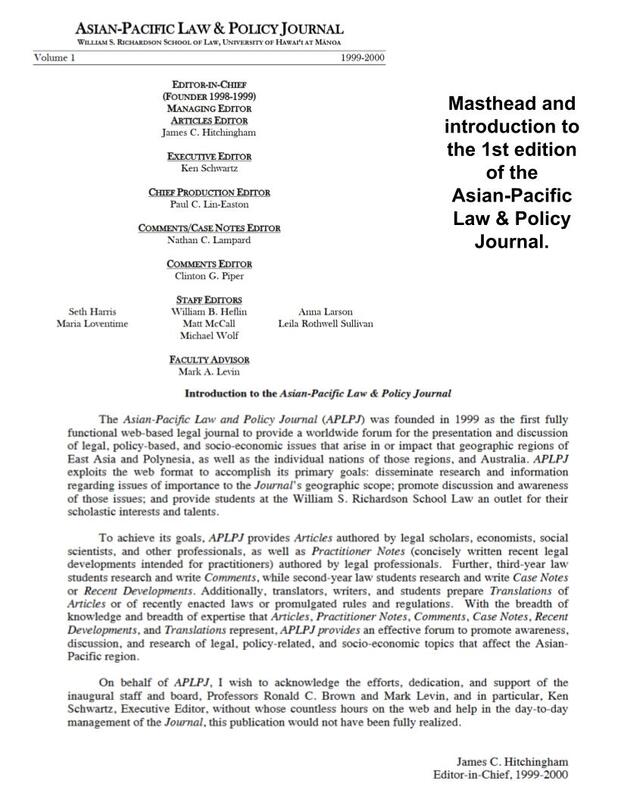
The Asian-Pacific Law and Policy Journal (APLPJ) was founded in 1999 to provide a "worldwide forum for the presentation and discussion of legal, policy-based, and socio-economic issues that arise in East Asia, Polynesia, individual nations of those regions, and Australia. Articles are authored by legal scholars, economists, social scientists, and professionals, as well as Practitioner Notes by legal professionals. Third-year law students publish Comments, and second-year law students write Case Notes or Recent Developments.

2004
Shirley Garcia directed the Ulu Lehua Program from 2004-2007.
During her studies as a Richardson Law student, Shirley Garcia's 2002 Second Year Seminar Paper won the Amy C. Richardson Award. Her paper argues for the State of Hawaiʻi to protect the cultural and natural resources of Hawaiʻi through meaningful, consistent, and permanent representation of cultural practitioners in decision-making that affects how land use and development proceeds in the state.
She provides an overview of
- the traditional relationship of Native Hawaiians to the ʻāina and
historical alienation from lands; - the Ka Paʻakai o ka ʻĀina v. Land Use Commission (LUC) case, and LUC's latest Decision and Order granting Destination Village Kauaʻi's petition to amend district boundaries in the ahupuaʻa of Makaweli, Kauaʻi;
- reviews the Decisions and Orders in the analytical framework
provided by the Ka Paʻakai court; and - explains why the framework failed to adequately protect traditional and customary rights because individuals enforcing these rights are unable or unwilling to give them sufficient and due consideration.
Source:
Law School History, Series 12: Admin, Faculty & Staff, Box 10, Folder 25.
2005
Hawaiʻi Innocence Project
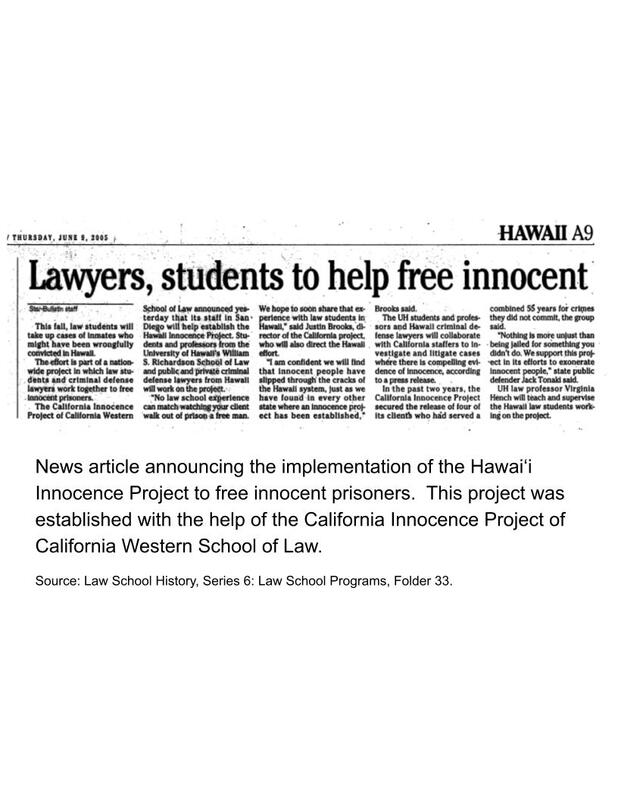
News article announcing the implementation of the Hawaiʻi Innocence Project to free innocent prisoners. This project was established at the William S. Richardson School of Law with the help of the California Innocence Project of California Western School of Law. Virginia Hench was the first teacher and supervisor of students working on the Hawaiʻi Innocence Project.
Family Court of the First Circuit
The Family Court of the First Circuit, which includes the City and County of Honolulu came into existence on July 1, 1966, under the authority of Act 232, Session Laws of Hawaii 1965. Its statutory right and authority to interpret and apply the law is now vested in the Hawaii Revised Statutes, Chapter 571, and supplements thereto.
Hawaii was the second state in the nation to adopt the Family Court concept.
The Family Court affords to children, minors, and adults under its jurisdiction all possible help in resolving their justiciable problems and conflicts.
- Services to Children and Minors under 18
- Adults
- Civil Matters
- Juvenile Referral Policy and Procedures
- Physical Facilities
Family Court’s Connection to the Law School
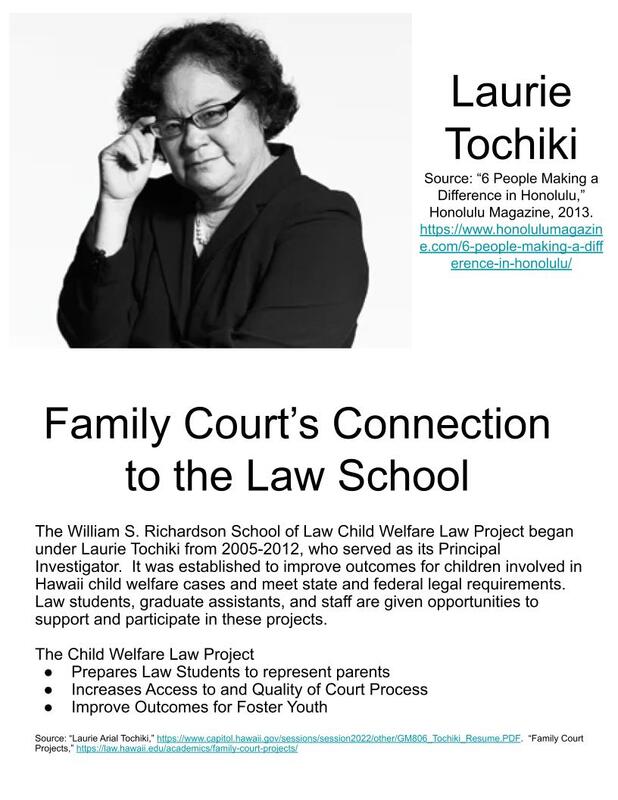
The William S. Richardson School of Law Child Welfare Law Project began under Laurie Tochiki from 2005-2012, who served as its Principal Investigator. It was established to improve outcomes for children involved in Hawaii child welfare cases and meet state and federal legal requirements. Law students, graduate assistants, and staff are given opportunities to support and participate in these projects.
The Child Welfare Law Project
- Prepares Law Students to represent parents
- Increases Access to and Quality of Court Processes
- Improve Outcomes for Foster Youth
Sources:
Chief Justice William S. Richardson, Series 6: Photos and Memorabilia, Box 7, Folder 37.
“Family Court Projects,” https://law.hawaii.edu/academics/family-court-projects/
Law School History, Series 6: Law School Programs, Folder 33.
“Laurie Arial Tochiki,” https://www.capitol.hawaii.gov/sessions/session2022/other/GM806_Tochiki_Resume.PDF.

2006
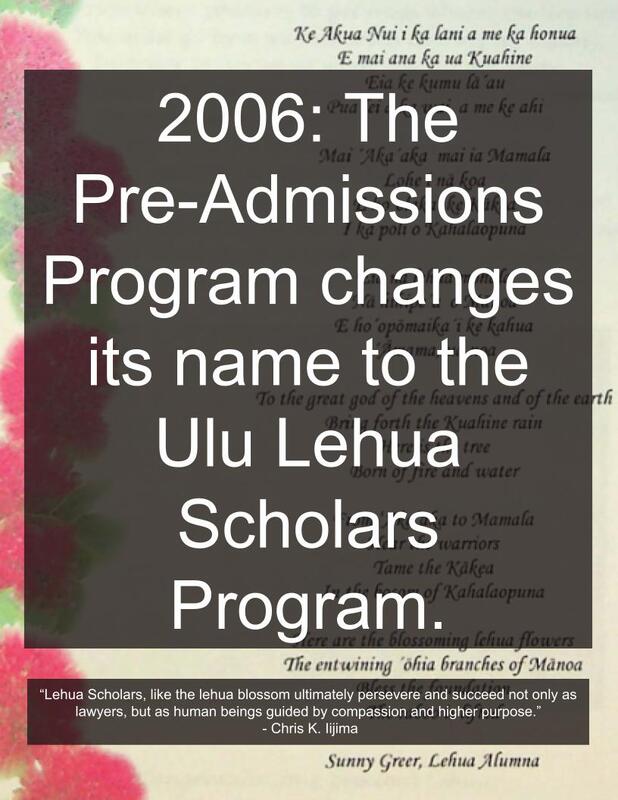
The Pre-Admissions Program changed its name to the Ulu Lehua Scholars Program.
“Lehua Scholars, like the lehua blossom ultimately persevere and succeed not only as lawyers, but as human beings guided by compassion and higher purpose.”
- Chris K. Iijima
Casey Jarman was hired as Director of the Pre-Admissions Program in 2006.

2007
Linda Krieger was hired as the Director of the Ulu Lehua Scholars Program in 2007.
“the eventual pass rate for Lehua students who entered law school during or after the fall of 2015 and took at least one bar exam by February 2015 appears to be around 72%.” - Linda Krieger
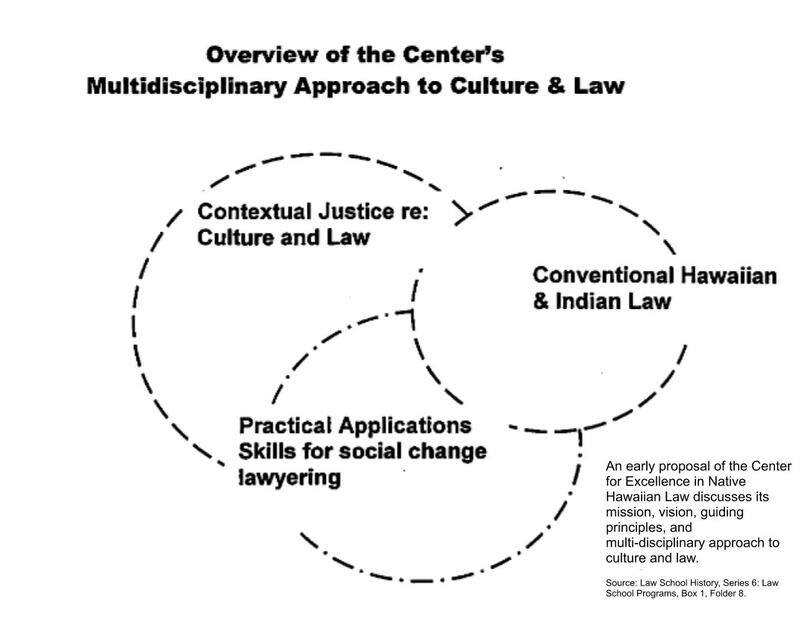
An early proposal of the Center for Excellence in Native Hawaiian Law discusses its mission, vision, guiding principles, and multi-disciplinary approach to culture and law.
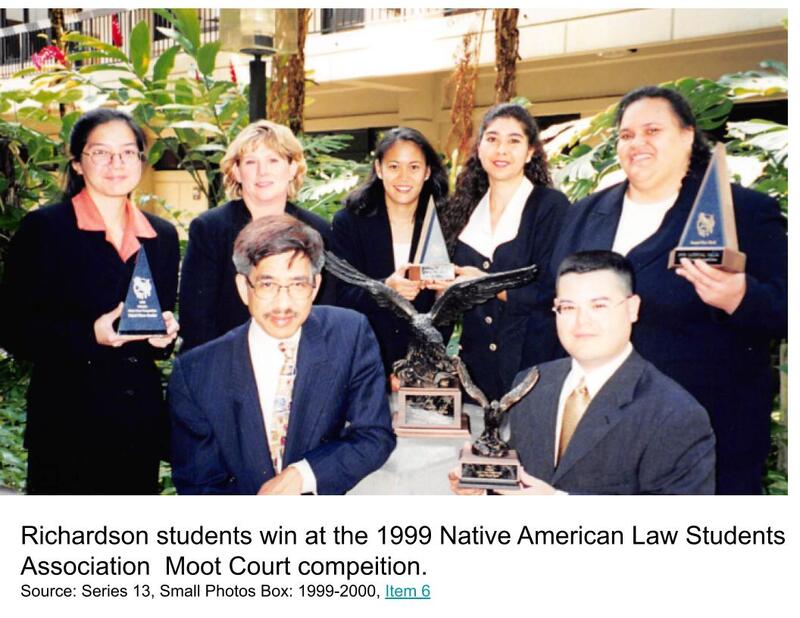
Richardson Law students win at the 1999 Native American Law Students Association Moot Court competition.
Sources:
Law School History, Series 12: Law School Administration, Faculty, and Staff, Box 1, LSHDA 3:49
Law School History, Series 6: Law School Programs, Box 1, Folder 8.
Series 13, Small Photos Box: 1999-2000, Item 6

2008
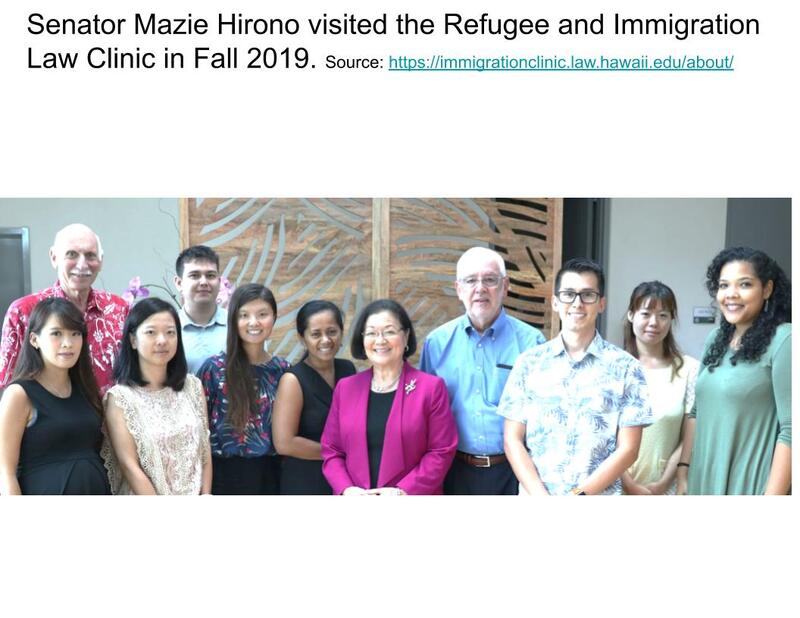
Refugee and Immigration Law
A grant application lays out an early vision of the Refugee and Immigration Law Clinic at the WSRSL.
Evening Part-Time Program
The Evening Part-Time (EPT) Program at WSRSL was created to support students who have full-time jobs during the day. Graphics in 2014 show how that the majority of students work from 30-40 hours per week, in addition to attending classes. The criteria for admission into the EPT Program are the same as the Full Time program, and that students have completed the program in 3 to 3.5 years, and some as long as 6 years. After graduation, many find legal and non-legal employment.
A 2012 survey shows the study interests of EPT students. They expressed "subjects tested on the bar" as their most interesting course.
Source: Law School History, Series 12: Law School Administration, Faculty, and Staff, Box 9, Folder 72.
2009
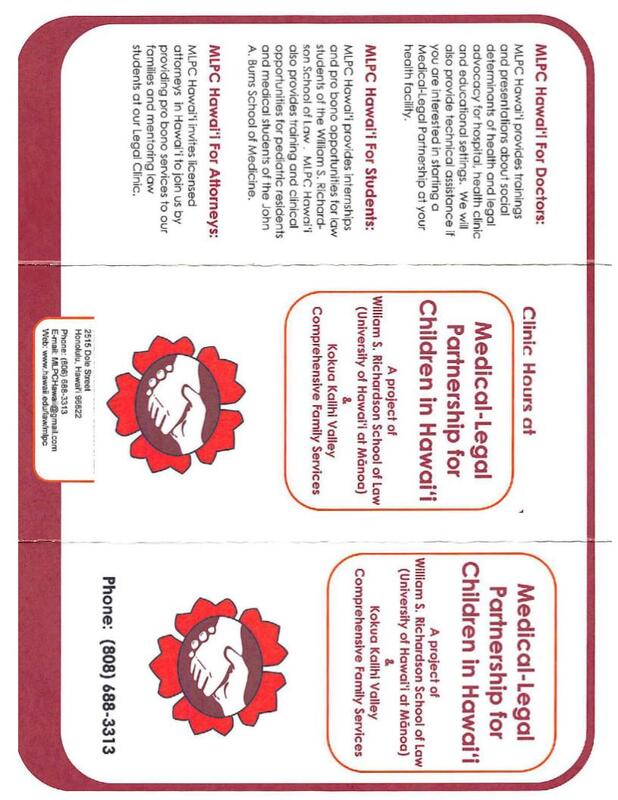
Brochure of the Medical-Legal Partnership for Children in Hawaiʻi, a partnership between doctors and lawyers to improve the health and well-being of vulnerable children and families in Hawaiʻi.
Source: Law School History, Series 6: Law School Programs, Box 2, LSHDA6(2), Folder 46.
2011
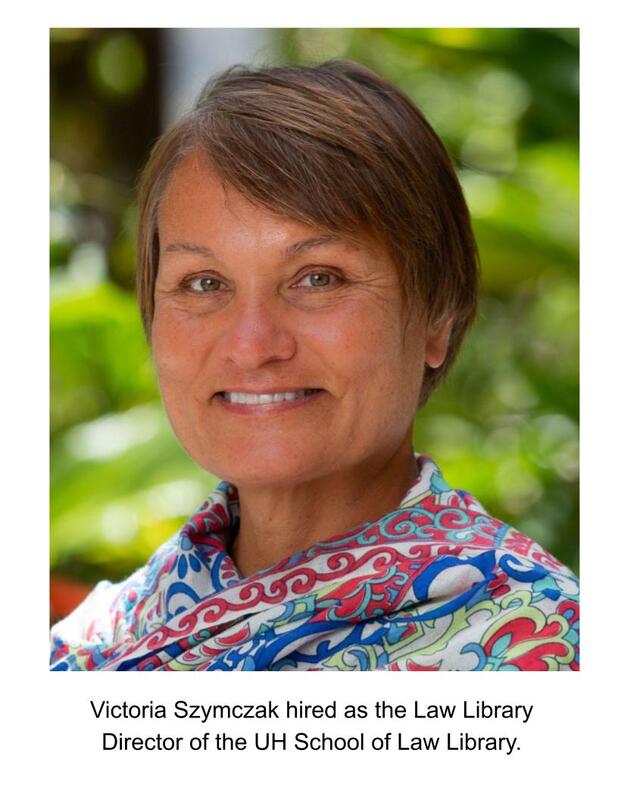
Victoria Szymczak was hired as the Director of the University of Hawaiʻi School of Law Library.

2016
Ulu Lehua Scholars Program
Troy Andrade was hired in 2016 to direct the Ulu Lehua Scholars Program.
“Director Andrade's appointment is particularly noteworthy because he is a graduate of the Law School and a Lehua Scholar, Class of 2011. Andrade personally understands the mission of the Program and the unique challenges experienced by the Lehua Scholars. His stellar career includes a clerkship with Hawai'i Supreme Court Chief Justice Mark Recktenwald, a recently awarded PhD in American Studies, and numerous academic and public service awards. He served as the Managing Editor of the University of Hawai'i Law Review, Pacific Business News named him as one of Hawaii's top forty leaders under the age of forty and he was identified recently as a Rising Star in Business Litigation by Super Lawyers.”
Law Library Renovations
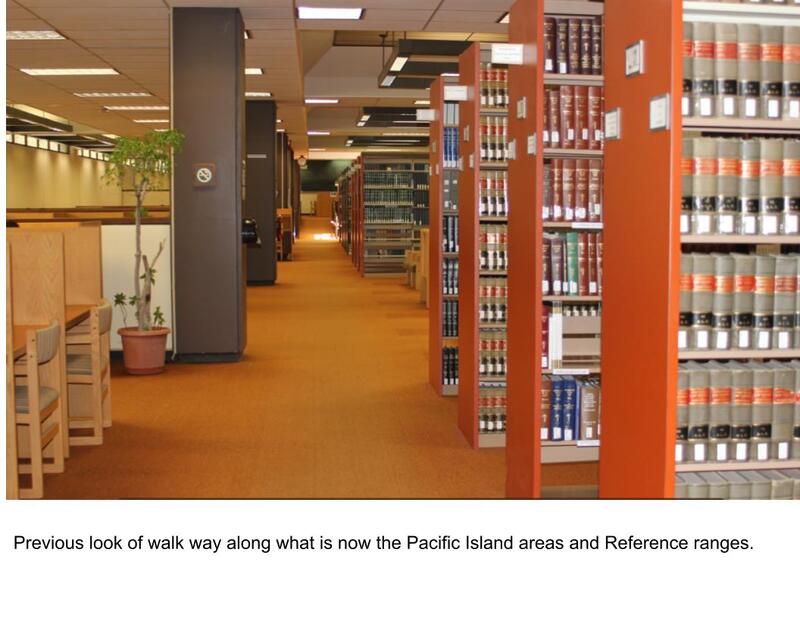
Law Library renovations were completed in 2016, addressing the American Bar Association's strategic priority to expand information services and resources to support the educational and scholarly activities of the Law School, the University of Hawaiʻi, and the extended legal community.
Sources:
Law School History, Series 12: Admin, Faculty, & Staff, Box 9, Folder 88.
“Self Study 2016-2017,” Law School History, Series 14: ABA 2011-2019 (folder level), Box 3, Item 3.

2015
The Law Library hosted the launch of the Judge Samuel P. King Archival Collection. The reception featured King's family members and Professor Randy Roth. Guests were able to view Judge King's scrapbooks, archives, and memorabilia.

2019
The Law Library hosted the Pacific Island Legal Institute reception featuring oral testimonies of judges from the Federated States of Micronesia, American Samoa, Hawai’i, and Law Students and Faculty from WSRSL. An archival exhibit presenting the history of the Law School's participation in the Pacific Judicial Education Program was featured, as well as intergenerational and intercultural dialogue on issues of customary law, colonialisms, and post-colonialisms affecting Pacific Island nations.
2020
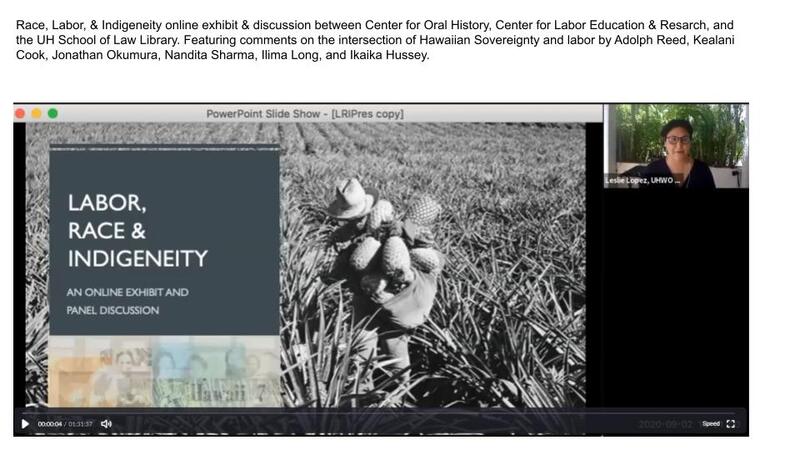
The UH School of Law Library Archives collaborated on an exhibit and discussion entitled "Race, Labor, & Indigeneity" with the Department of Ethnic Studies Center for Oral History, UH West Oahu Center for Labor Education & Research. It featured comments on the intersection of Hawaiian Sovereignty and labor by Adolph Reed, Kealani Cook, Jonathan Okumura, Nandita Sharma, Ilima Long, and Ikaika Hussey. The event was a zoom webinar event that took place during the start of the COVID-19 pandemic. The archival exhibit and a recording of the discussion have been preserved here.